As businesses contended with macroeconomic headwinds in recent years, marketing budgets have been risk averse and restricted. Now, with markets beginning to shift in 2026, budgets are starting to loosen, and more capital is being deployed.
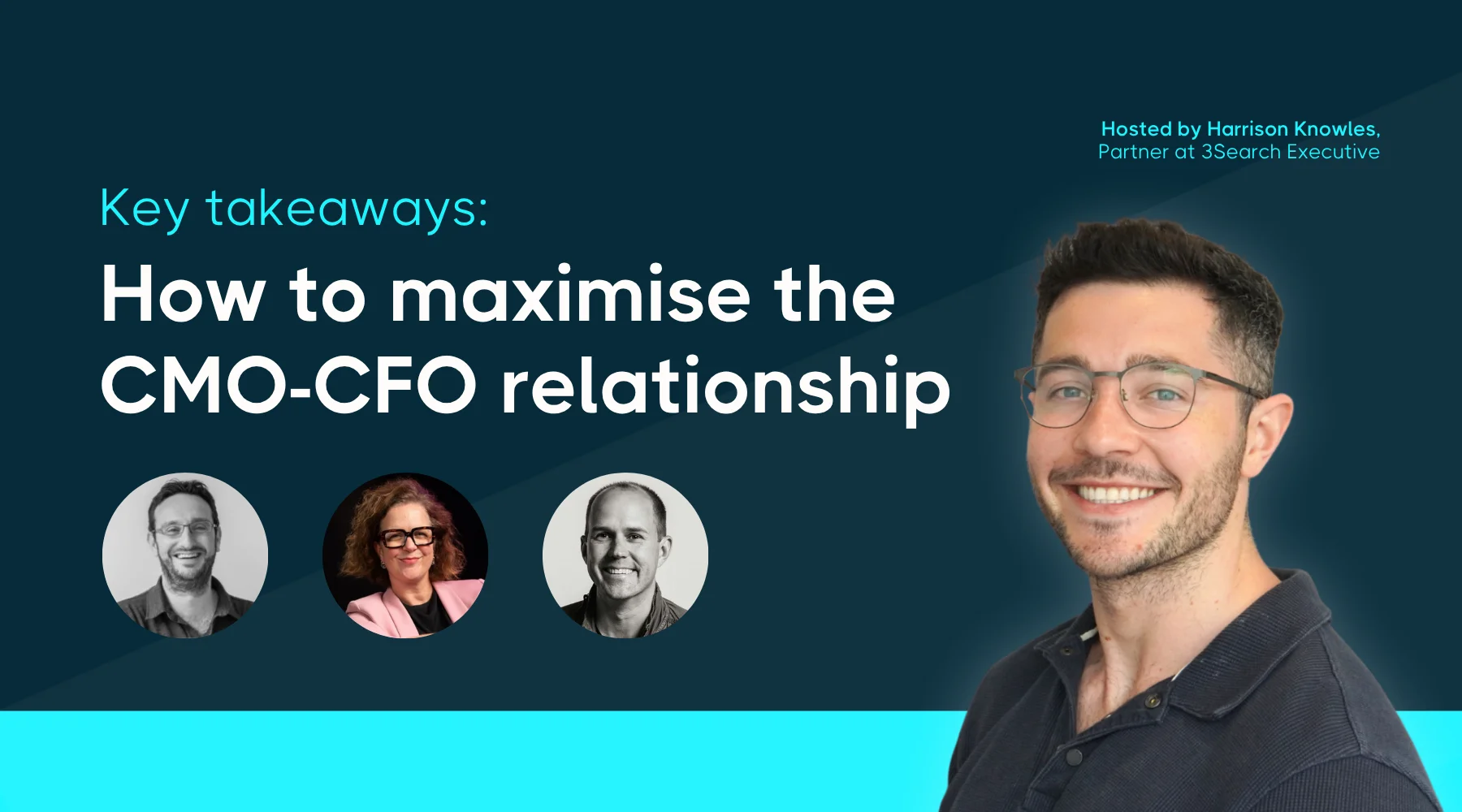
To help marketers prepare for this shift, Harrison Knowles hosted a seminar event exploring how to maximise the relationship with your Chief Financial Officer. Attendees heard from a curated panel of both CMOs and CFOs, including:
- Nick Smith, CFO at Little Moons, formerly Huel and Orlebar Brown
- Louise Cruttenden, CMO at The REAL Co, formerly, JAAQ. and Huel
- Seth Bindernagel, CMO at MOSS, formerly Twitter and Strava
Throughout the evening, they discussed:
- Profitable growth is the CMO & CFO’s shared objective
- A good CMO-CFO relationship is built on trust
- The relationship evolves as you move between growth cycles
- Brand investment is justified through agreed parameters
Continue reading for the full recount of the conversation.
The C-suite objective
While the Chief Financial Officer and Chief Marketing Officer’s roles are often framed as opposing, both are ultimately working towards the same objective: growth. Our speakers summarised each role’s objective as:
- CFO: Helping the company grow as fast and as profitably as it can without burning cash
- CMO: Delivering sustainable, profitable and – most importantly – predictable growth
As such, to reach their shared objective, alignment between the two leadership roles is critical.
Structure of the relationship between finance and marketing
The key difference between the two leadership roles is board visibility. Nick Smith shared, “You do find yourself as CFO in the position of being accountable for basically everything in front of the board along with the CEO. Quite often in a board context, I will be the CMO’s voice as they're not always in the room.”
This creates a dependence on each other. In many organisations, especially within the software industry, there is a lot of reliance placed on the marketing department in predicting annual growth.
Seth Bindernagel said, “My relationship has always been very close with the CFO, because the finance team will come to us and say, ‘We’re planning all of 2026, what are your growth projections?’ Because that is the starting point from how we’re going to actually scale the business.”
What does a good CMO-CFO relationship look like?
Trust is key for a good relationship between the CMO and CFO. Clarity, forecasting discipline and agreed guardrails are crucial for building trust between the two.
What does a CFO expect from their CMO?
As our CFO panellist, Nick shared that a strong CMO–CFO relationship isn’t built on the CMO knowing every finance nuance; it’s built on clear parameters and the right shared KPIs set by finance. His expectation of the CMO is then to respond pragmatically.
For example, given the markets leadership has prioritised, what is the plan to accelerate growth there, and how will you prioritise across markets/channels/products based on the underlying drivers?
“I think from a CFO point of view, if a CMO or a marketing team can explain why they're doing what they're doing and why they're not doing other things, that gives you confidence,” says Nick, “Use all the data you've got and invest in spending time to understand what it all means and how investors and financial people look at it, because that's ultimately where you'll be going.”
How can CMOs curate a collaborative relationship
When you work with a CFO who simply doesn’t understand marketing, your relationship can quickly become a barrier to success. While Louise Cruttenden emphasised that this is the exception and not the rule, it’s incredibly important to educate your finance counterpart before “being able to have the forward-looking conversations and make decisions that were going to drive growth.”
The CMO-CFO relationship must evolve as financial parameters change
There is no fixed operating model for the CMO-CFO relationship. As the financial context of the business shifts, the partnership must evolve.
As companies move between growth cycles, the expectations placed on marketing change materially. What may feel like a simple shift in wording (for example, from “growing while not losing money” to “growing while increasing EBITDA”) fundamentally alters the trade-offs marketing is being asked to make. In these moments, alignment matters most.
Maintaining a strong relationship between growth cycles
As you move between growth cycles CFOs are tasked with recalibrating capital allocation as external conditions, investor expectations or liquidity change. Meanwhile, CMOs must adapt their plans to deliver growth within tighter (or different) constraints.
The strongest partnerships are those that treat this as an opportunity to reset, re-agreeing priorities, success metrics, and time horizons.
Maintaining open dialogue throughout this period is critical so marketing efficiency improves without undermining long-term brand and demand creation. When handled well, this evolution strengthens trust between the CFO and CMO rather than eroding it. It ultimately enables the business to change pace without losing direction.
How can alignment encourage justify brand investment
For many CFOs and boards, brand investment still feels harder to defend than performance spend. Not because it lacks value, but because it often fails to start with the same commercial discipline. However, that does not mean that brand should sit outside of the growth conversation.
Strong alignment with your Chief Financial Officer makes it far easier to encourage brand investment.
Reframing thinking around brand marketing
Louise shared how she has reframed thinking, “All marketing is measurable. It’s about defining your hypothesis before you go in, saying ‘If we do x, I believe we will achieve y.’ Now, I avoid the debate around ‘Is it brand building or is it performance marketing?’ It's marketing, and the job of all marketing is to grow and recruit new consumers and keep the ones you've got.”
The mistake that often derails CFO confidence is framing brand as intuition-led or long-term by default. Instead, CMOs should lead brand efforts with a set of testable growth hypotheses, with clearly defined objectives agreed upfront. When brand investment is explicitly tied to those outcomes...
- improving conversion efficiency
- expanding category demand
- or protecting pricing power
...it becomes a commercial lever, not a discretionary cost.
Measuring and proving brand impact
Seth Bindernagel reinforced this point from the software sector, where feature parity erodes differentiation. In hyper-competitive markets, brand becomes the commercial distinction that creates emotional relevance where product claims alone fall flat.
While harder to isolate, brand impact can still be measured through controlled experiments. This includes geographic pilots, messaging splits in performance media, brand lift studies, and cohort analysis over time. However, what matters most to CFOs is not perfect attribution, but evidence of a thought-through system. Investment proposals land more effectively when CMOs define:
- the hypothesis behind the activity
- the metrics that will signal success (beyond immediate conversion)
- the timeframe over which impact should reasonably show up
- and the optionality (what can be paused, scaled, or redirected if early indicators are weak)
The strongest CMO-CFO partnerships don’t ask whether brand is measurable, they agree upfront on how it will be measured, when, and why it matters to growth.
Alignment is a growth advantage
As marketing budgets begin to loosen and scrutiny inevitably follows, the strength of the CMO–CFO relationship will increasingly define which organisations deploy capital effectively and which don’t.
What emerged clearly from the discussion is that alignment is not about consensus on every decision. It’s about shared accountability for growth, a common language around risk and return, and enough trust to challenge assumptions without eroding confidence. The most productive partnerships are built where marketing operates within clearly defined financial guardrails, and finance understands marketing not as a cost centre, but as a growth system.
We want to extend our gratitude to our speakers for their time and insights shared. If you’re seeking further advice on effective marketing leadership, we would recommend reading:
- How to best work with a founder as a marketing leader
- Marketing leadership for early-stage start-ups
For support in building your commercial leadership team, get in touch with our marketing executive search specialists. With our unique Advise, Attract, Develop practice, we will identify the right talent for your growth.