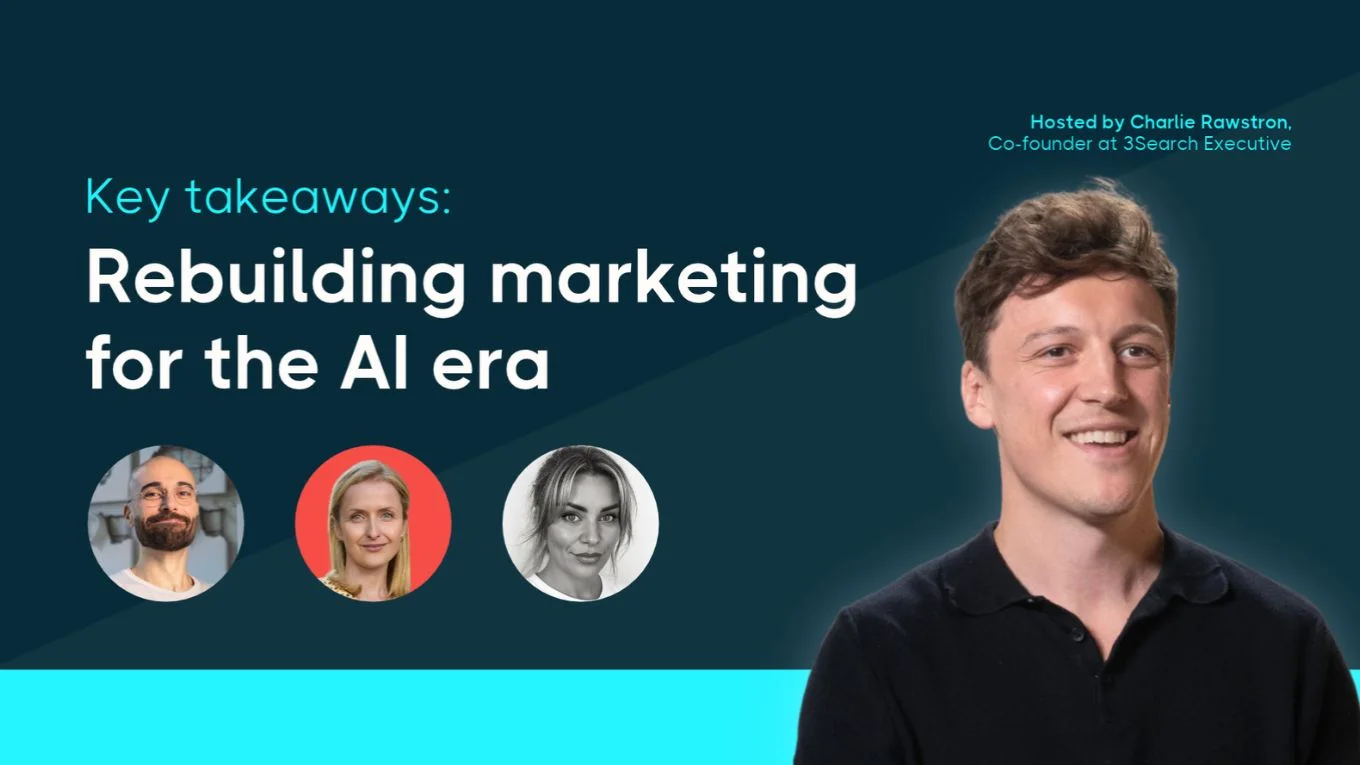
AI transformation is at the top of Chief Marketing Officers’ priority list, but with so much still to learn and so many challenges to tackle, how do you know where to start? On Thursday 1st October, our Co-founder Charlie Rawstron hosted a panel discussion on rebuilding marketing for the AI era. He was joined by:
- Duarte Garrido, Co-Founder and CEO of Dojo AI
- Victoria Rusnac, Founder and AI Coach at Applied AI Academy
- Jada Balster, VP Global Marketing at Perk
With over 100 marketing professionals in attendance at the Royal Air Force Club in London, we discussed what the marketing team looks like in the AI era, how AI is transforming the fundamentals of marketing, and how you can lead that transformation. Here are our 8 key insights from the discussion:
- Building with AI will build your understanding
- AI adoption requires time and space
- Establish the business need first
- Choose the right AI tools for the problems
- Human creativity is crucial
- High-quality AI talent is currently hard to find
- Organisational structures are evolving
- AI adoption is everyone's responsibility
Continue reading to learn more about each.
1. Building with AI will build your understanding
The best way to truly understand AI is to build active systems with it, not use it as a chat assistant. "I think building is the biggest step towards understanding the technology that is evolving with the craziest pace," said Victoria. While most marketers are still stuck at the assistant stage, AI's moving so quickly that Victoria would have to rewrite 30% of her course content every two months just to keep it current.
Agentic AI vs GenAI
As you begin exploring AI, it's important to recognise the difference between generative and agentic. Generative means you chat, get an answer and copy it into your email or website, while agentic means connecting tools such as your CMS, email and reporting, so the AI works alongside you. Victoria's advice for beginners is to start building with AI agent tools like Claude and Codex, and link them directly to their local files, apps and data sources. This will allow you to actually build, rather than just complete simple one-off tasks.
2. Effective AI adoption requires patience
When it comes to adopting AI, a marketing leader's scarcest resource is often time, not money. It's one thing saying AI is a priority, but adoption won't happen unless you give yourself and your team the space to learn. "Have you tried yourself to adopt AI?" said Victoria. "Going through the journey, you will understand what it takes to get your team on it. So for me, don't think about money. Just think about giving yourself space and time to really learn the technology, play with it and then it will be absolutely obvious to everyone in this room how to drive your team adoption based on your leadership style, based on your culture."
Encourage and make space for learning
When we have no idea where to start, Jada feels we should not be ashamed of asking "dumb questions" of AI tools in order to increase our understanding. "Ask your tool how to do things," she said. "I don't know how to do this... How can we build something together?" Marketing leaders should treat building as non-negotiable, encouraging their teams to share their agents and workflows with the wider team to learn from one another. However, we should also expect productivity to dip before it rises.
3. Begin your journey by establishing the business need
Marketers have a long history of rushing into new technology and creating more work for themselves, but doing more is not the same as doing better. "The first thing, is to have a look at where the pain is," said Duarte. Once we've identified the real business need, we then need to decide which tools and functions will help to address it.
AI is no longer the aspiration but the norm, with most organisational tech stacks now including AI tools. "It's almost like a post-AI world now," he said, "and we need to look at what tools we actually need, with what functionalities to make us better at our jobs, and happier and more fulfilled."
4. Select the right AI tools for the right jobs
It's very easy for human beings to get lazy, particularly when it comes to their use of AI, but conversational AI isn't right for everything. If you're editing a PowerPoint, for example, it's far easier and more precise for you to update it manually.
The panel agreed that AI delivers fastest in four key areas:
- Analytics and reporting: Showing the quality of your output and saving you time, AI’s data analysis capabilities are ideally suited to winning over sceptics. Using AI to handle spreadsheets and workflows also frees up the more creative-minded to focus on their strengths.
- Cost per acquisition: AI finds patterns across silos. Looking at SEO, ads and website data as one ecosystem helps to improve your effectiveness as well as your efficiency.
- Content with guardrails: The more effort you put in, the better the result. A full workflow with a quality assurance (QA) loop will produce much better output than a single prompt. You can even go beyond churning out content and build a tone-of-voice agent that gives instant feedback on anything written.
- Replacing point solutions: Building a paid search agent to replace an expensive tool can help you make massive savings while picking up anything the tool missed.
5. Human creativity is pivotal to maximising AI tools
AI should not just be treated as a way to do last year's work with half the team; it needs to be supplemented with human creativity in order to bring the maximum benefit. "Get people who are really talented to be really creative and to generate ideas that are fresh, that no one's ever read before," said Duarte. "AI is not there to do that. AI does not generate fresh creative ideas. It recycles them in a really good way and you can use that, but don't lose your creative spark."
Who you hire matters most
When everyone has the same tools, differentiation comes from your people. Given the time and freedom to create, Jada's team have become particularly skilled adopters of AI, building a tone of voice agent to help everyone in the business stay on brand in their content. "It's been really, really helpful. When people write content, they get feedback immediately." Similarly, a Claude-based slide agent has significantly improved the quality of slides created across the business, and AI-powered translation and localisation are helping to save on agency fees.
6. High-quality AI talent is in short supply
There was a feeling among our panel that the AI talent market is very thin, which means you often need to think outside the box when looking to strengthen your team. One solutions to the talent shortage is to hire AI coaches and grow the talent internally. The panel also recommended looking for original critical thinking, creativity and intelligence rather than specifically AI skills.
How to identify AI skills in the hiring process
When speaking to potential hires, it's important not to rule out strong marketers whose current employers haven't given them the chance to build with AI. Instead, ask candidates to show you what they've built. If a candidate is experimenting in their own time, that's not only valuable from a skills perspective, but also shows their willingness to learn.
7. Organisational structures are shifting
Our panel couldn't entirely agree on how organisations would be structured in the long-term, but there's no doubt that AI is shifting structures:
- 3Search Executive Co-founder, Charlie Rawstron, shared that he is seeing the typical pyramid transitioning into more of a rectangle, with organisations hiring fewer, more generalist professionals.
- Victoria expects CMOs to become orchestrators of agentic systems, with a reduction in coordination-heavy manager roles and more compact teams.
- Duarte, on the other hand, doesn't believe that marketing teams will get smaller, or in individuals running swarms of agents, because people are "the only thing that actually scales the business."
Where everyone agreed was that senior people with strong judgment, keen commercial nous and boardroom credibility remain irreplaceable.
8. AI adoption is a shared responsibility
By giving your team the tools, the time and the trust they need, you can really accelerate your AI journey. With her team's two main barriers being time and confidence, Jada split them into groups and set them a six-week challenge to build a live demo, based on real use cases. With time blocked out each Friday and an AI Engineer dropping into sessions to offer guidance, the result was a big jump in engagement and confidence because the projects solved real challenges.
The next step is moving AI from a personal productivity tool to an interconnected organisational infrastructure. This could be through a shared data, context and agent layer, with UX on top. If there's no settled best practice in your organisation for building, updating and sharing feedback, teams could improvise with tools like Notion or Glean. However you get there, achieving this shared responsibility "is going to be the game changer," said Jada.
Start now and stay consistent
Scaling AI across your organisation is very much an ongoing journey: start now, stay consistent and accept that it will feel uncomfortable. To remain relevant, today's marketing leader needs to combine real expertise with the ability to channel that expertise into AI agents, but remember there's a difference between being busy and making an impact.
For more reading on this topic, catch up with Victoria Runsac's key takeaways from the morning.
Build your marketing team for the future
The marketing team is constantly evolving - the skills, job titles and structures never look the same.
We're always speaking to marketing leaders who are building on their AI journey. Our team of specialist headhunters are consistently building on their understanding of the AI challenges facing organisations and crucially, how they're approaching them. If you'd like to join us for our next event, or you're a marketing leader looking to build a marketing team for the AI era, contact our marketing executive search team.