
The ambition to become a Chief Executive Officer (CEO) often sits somewhere in the background of career planning. Yet, despite evidence that marketers are increasingly moving into the CEO role, the transition from functional expert to chief executive remains one of the most challenging moves in business.
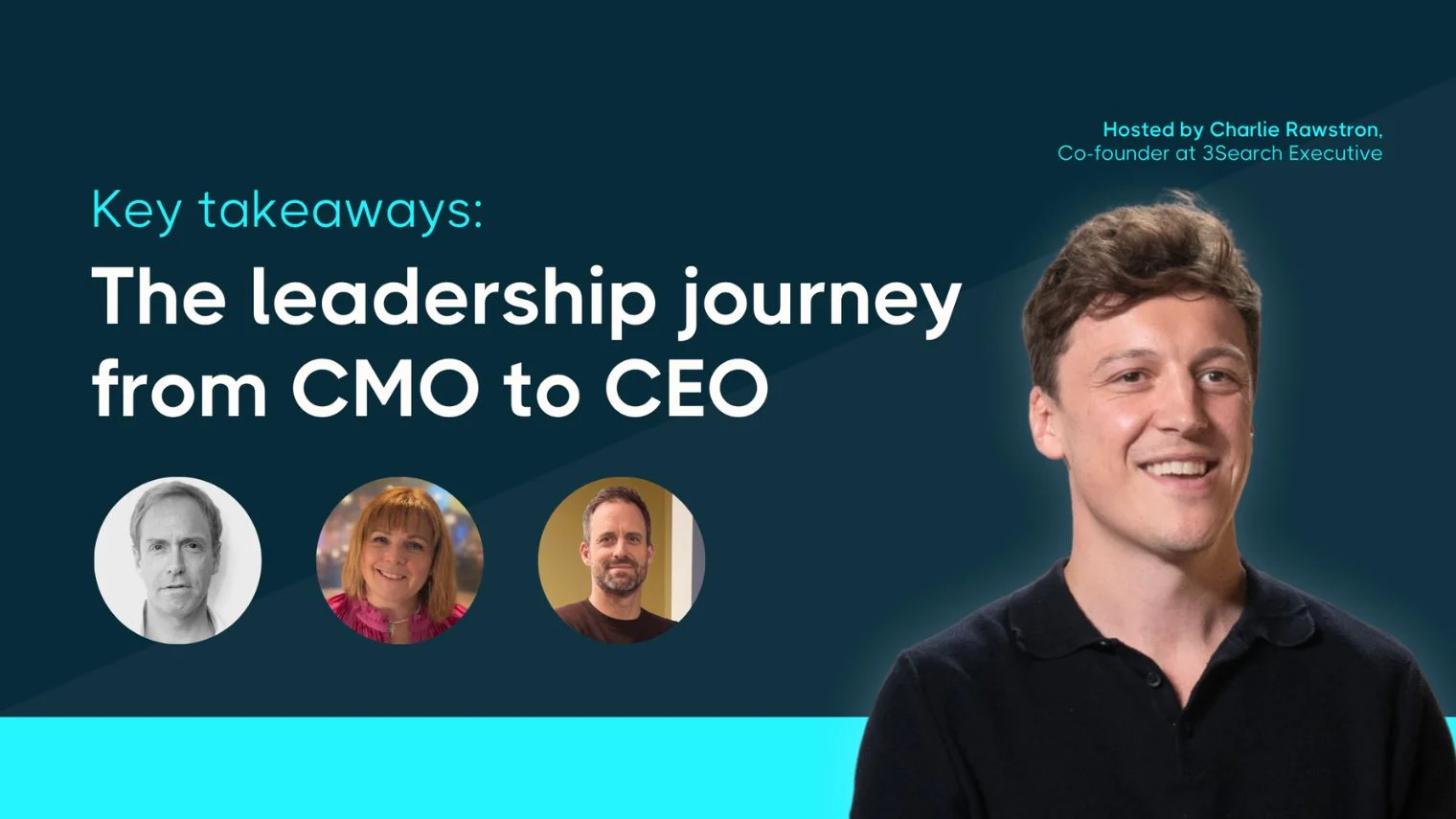
On July 2nd, 3Search Executive hosted ‘From CMO to CEO: How to make the leap and succeed at the top.’ Here, we brought together three leaders who have successfully made the journey themselves to share their journeys with aspiring CEOs.
Event speakers
Led by 3Search Executive Co-founder, Charlie Rawstron, attendees heard from:
- Lysa Hardy – UK CEO of Café Nero and former CEO of Hotel Chocolat, where she progressed from CMO to CEO.
- James Sturrock – CEO of Bella+Duke, former CEO of eve Sleep and Tapi Carpets, whose career spans marketing, ecommerce, revenue leadership and general management.
- Simon Drakeford – CEO of Utility Bidder LTD and former CEO of EO Group, with a background in marketing, ecommerce and SaaS leadership.
Across the discussion, several consistent themes emerged. The panel explored:
- Why customer-centric thinking remains one of the greatest leadership advantages marketers possess
- How aspiring CEOs can build commercial credibility
- Why broad business experience matters more than a perfect career ladder
- The realities of stepping into what can often be a surprisingly lonely role
If you’re a Chief Marketing Officer (CMO) wanting to learn more about the CEO role, continue reading for real advice.
Is the path from CMO to CEO viable?
Recently marketing careers become a popular pathway to broader leadership opportunities – rather than simply a career destination. The CEO role is no exception.
While traditional CEO appointments have long favoured finance, operations and commercial leaders, recent research reveals that around one in ten CMOs leave their roles to become CEOs. Our panellists shared why the marketing CEO is becoming more popular and what difference they bring to the table.
Why CEOs with a marketing background are growing in popularity
Each of our panellists had taken different routes into the CEO role. None viewed their marketing background as a disadvantage and, in fact, they argued the opposite.
For James Sturrock, one of the most valuable attributes marketers bring to leadership is an obsession with the customer.
He described customer understanding as one of the key reasons boards and investors increasingly see marketing leaders as credible CEO candidates.
"If you don't get it right for the customer, you've not got a business,” said James, “I think that's definitely something that boards investors look for in a CEO – being customer obsessed. Not just for your external customers, but also for your internal customers – your staff.”
Lysa Hardy agreed, arguing that marketers are often better equipped to look beyond the four walls of the organisation.
Marketers understand changing customer behaviours, competitive pressures and broader market trends. Those habits become even more important in the CEO seat, where balancing internal mindset with external relevance is critical.
"I didn't hear the word customer once,” said Lysa, “I heard a lot about numbers and compliance and sales, but not about the customer."
This is a challenge that many organisations face as they mature. Senior leadership teams often focus on internal metrics, operational processes and efficiency targets at the expense of understanding how customer expectations are evolving. Marketers, Lysa argued, are uniquely positioned to change that thinking.
Simon Drakeford brought an internal lens, too, arguing that marketers are uniquely capable of positioning the brand to speak to all customers.
Drawing on his experience leading smaller, growth-stage businesses, he described business leadership as an extension of the same principles marketers already apply every day. This includes understanding audiences, communicating value and building trust with multiple stakeholder groups.
"I'm not only building a brand for my customers, which is very important, but I'm also building a brand for my investors, my employees or potential employees,” said Simon, “I'm constantly marketing my business to all stakeholders, not just to my customers."
The ability to balance multiple stakeholder perspectives is just one reason why marketing leaders are credible CEO candidates. In competitive markets, organisations require leaders who can confidently communicate the vision internally and externally. Marketers arrive with those skills already well developed.
How to make the transition from CMO to CEO?
To transition from marketing leadership to CEO, you must be more than an exceptional marketer. Boards are not looking for someone to lead marketing from the CEO seat; they are looking for someone capable of leading an entire business.
That means understanding how decisions drive growth, profitability, operations, culture and long-term value creation – not just brand performance. There are several actions that senior marketers can take to broaden their leadership skills and prepare for the role.
Broaden your perspective outside of the marketing department
Aspiring CEOs must broaden their perspective beyond the boundaries of the marketing function. While marketers have strong commercial instincts, they aren't always exposed to the full mechanics of a business, particularly around financial management and P&L accountability.
Recognising this gap, Lysa deliberately sought opportunities to expand her remit beyond marketing. Rather than viewing the CEO opportunity as the next rung on the career ladder, she looked for ways to take ownership of commercial functions, ecommerce operations and wider business performance. That broader exposure ultimately helped prepare her for executive leadership.
Build commercial credibility
Despite marketing’s growing influence within businesses, there can still be a perception that marketers are focused on spending money rather than creating value. To counter that, aspiring CEOs must demonstrate a clear understanding of how marketing activity translates into business outcomes. Marketers must be able to explain not only what they are doing, but why it matters commercially.
Simon highlighted the importance of building a strong financial understanding. Curiosity is a critical ingredient in achieving this. Rather than staying within the confines of a specialist discipline, future CEOs should actively seek exposure to finance, operations and the mechanics of how a business makes money.
“Be the glue or the conduit within the organisation and use that to gain access to as much financial information as you can,” says Simon, “Find a friend in your finance partner where you feel comfortable asking the difficult questions about cash flow modelling, for instance, which can be really scary.”
Learn the language of business
Perhaps the most practical advice came from Lysa's experience of joining her first board. Lysa quickly realised that the challenge wasn't the quality of her thinking, but the language she was using to communicate it.
Surrounded by experienced board members with finance and operational backgrounds, she found that marketing terminology often created distance rather than influence.
“I didn't change anything I was doing day-to-day, but how I talked about it at the board was totally different. And that transformed my relationship with that board and how I was able to influence.”
When it comes to influence at board level, it's equally important to understand what matters to different stakeholders. Whether board members focus on growth, margin, operational efficiency or investment returns, aspiring CEOs must learn how to connect their ideas to the priorities sitting around the table.
Understanding the realities of the CEO role
Before pursuing your first chief executive role, James shared the importance of understanding your motivations, priorities and ambitions.
“Really understand your drivers and what makes you tick.”
Our panel were incredibly honest about the realities of the CEO role. The role is truly unlike any other position within the executive team, so it’s important to understand whether it is right for you before accepting a position.
Working in isolation
While incredibly fulfilling, the role can also be lonely. Decisions ultimately rest with you, difficult conversations cannot always be delegated, and there are fewer people inside the organisation with whom you can openly share concerns.
The panel stressed the importance of building a support network of mentors, chairs, fellow CEOs and trusted advisors. These relationships provide a valuable sounding board when navigating difficult decisions and periods of uncertainty.
Your executive career with 3Search Executive
3Search Executive is a specialist go-to-market search firm, partnering with high-growth brands to appoint leadership talent. Connect with our headhunters to learn about the mandates we’re currently working on.
Learn more about potential career opportunities
Marketers often find it difficult to picture what comes next in their CMO career. Throughout our events series, we have shed light on several roles that marketing executives can pursue – from fractional opportunities to non-executive roles.
These events are a part of our commitment to developing your careers, employees and businesses.